Saturday, April 7, 2012

Spanish Semana Santa

Semana Santa, or the Holy Week leading up to Pascua, Easter Sunday in Andalusia, should be on everyone's life bucket list. I've never seen such a joyful and reverential expression of cultural and religious tradition in my life. Each day of the week, a number of pasos, or processions, consisting of costumed members of the church, a uniformed band and a religious image carried on a trono by dozens (as many as 30) costaleros, parade through the city. 

With all of my American friends off traveling and no school because Semana Santa is spring break in Spain, I spent an amazing week completely immersed in Spanish culture; viewing processions, speaking tons of Spanish, and spending all of my time with my Spanish friends. I know I've already said this countless times, but I'll say it again - don't spend all of your time traveling while studying abroad. Traveling is amazing, but so is delving into your own host country and its unique culture. 
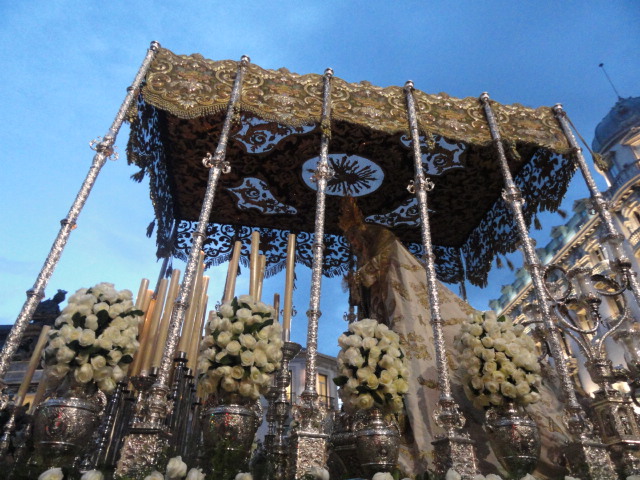


A cloud of incense announces the coming image. Incense and music are an important part of the paso; the distant, haunting sound of the march, the odor of incense and the excitement of people flocking to view the image make it easy to find the processions (luckily, for those of us without itineraries). 

I understand the inevitable mental link between the capirotes of the procession participants and the KKK, but the spiritual rituals of Andalusian Semana Santa were around centuries before similar masks became a symbol of intolerance and hate.

A trono making it's dance-like return to its church; these two resourceful kiddos enjoyed the same privileged view as Fray Luis.


2 am, Cristo de los Gitanos (Christ of the Gypsies). This is the most popular procession in Granada, and I've never seen so many people packed into the Sacromonte. Because the road was blocked with people, to watch the procession, we had to hike up and around through the neighborhood.  Looking down on this revelry with a view of the Alhambra against the night sky was more than worth it.
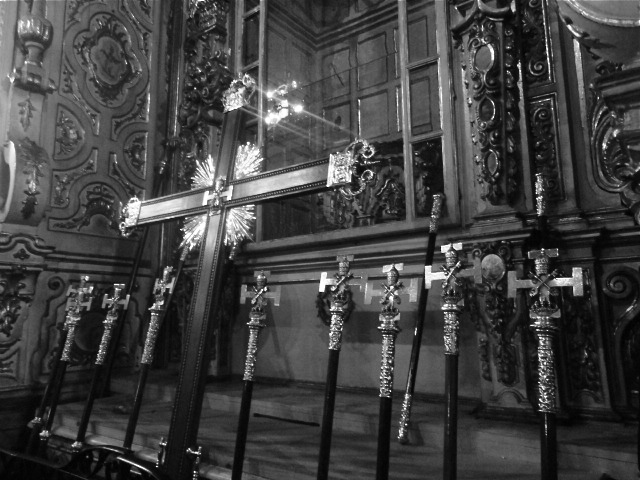

The llamador (literally door knocker) on the front of a trono, used to alert the costaleros who carry the   - image in absolute darkness, from beneath - to pick up or set down their burden.

Nuns dressed in white praying in a tiny chapel in the Albaicin. 


Photographs of the sick placed at this shrine of the Virgin Mary.

When I wasn't watching processions this week, I explored churches of Granada; here more mementos of the sick placed at the feet of Christ.


Jueves Santo, a trono depicting the crucified Christ marching by.

A penitent wearing gold and purple nazareno, or robes, featuring the famous capirote (hood), which I've heard many children here call cucurucho (ice cream cone).

Ok I confess, most of the Virgin Marys look very similar to one another, but each one is nonetheless 
very impressive. This one, Nuestra Señora de los Dolores was the only brave soul to make its paso despite the threat of rain on Lunes Santo. Seeing it return to its church (a long, complicated 
process of turning around and backing in the doorway) and hearing a saeta (a mournful, flamenco inspired singer) took my breath away.


I was introduced to this image by a friend while it was still being readied for Semana Santa weeks ago. It kicked of the Semana Santa as the first image to leave on Palm Sunday.

The only procession on Sábado Santo, this one is named Hermandad Sacramental de la Santísima Trinidad y Nombre de Jesus y Real e Ilustre Cofardia de Penitencia de Nuestra Señora de las Angustias Coronada de Santa Maria de la Alhambra. It's also called La Virgen de la Alhambra. 


After a long afternoon, the image returns to her church in Real de la Alhambra at 1:50 in the morning. Just look at that beautiful silver trono, designed to look like the Moorish architecture of the Alhambra.

Mujer de mantilla, or a woman in the procession wearing a black dress with the traditional peineta (the crown-like comb) and mantilla (lace veil). 


This was one of my favorites, a small image carried by children 
(I believe it's nicknamed el paso de los niños), when I saw it coming through the crowd 
I marveled at how low to the ground and little it is... ah that's why.

A popular Semana Santa pastime amongst younger member of the processional audience - collecting wax. A good example of the Spanish cultural attitude, the processions are loosely organized and surprisingly relaxed, so there is always more than enough time for youngsters to scramble between penitents amassing lovely globs of candle wax.

Don't mind me, just taking a picture of the er, church. Among my friends here in Spain I've developed a reputation as the strange one who takes pictures of other people's children. How can I help it? This little fellow and I had a real connection.

Feet of the costaleros carrying the image on its trono
walking to the music of the band in sync. 


Domingo de Resurrección, the last procession to pass through the city, with the image of the resurrected Christ and pure white nazareno, or penitential robes.

I am so lucky to have such fun, knowledgeable friends to share the Semana Santa with! 
(J isn't actually a vampire.)

Sunday, March 25, 2012

Poco a poco: climbing the language barrier

If I have to look up the verb dejar (to leave or let) in any of it's charming tenses one more time, I'm going to lose it.

A few pages later.
'Dejéis'? Oh what's this?

Flip to well-worn page in my dictionary.... Discover it is the present subjunctive of dejar.......

Damn it.

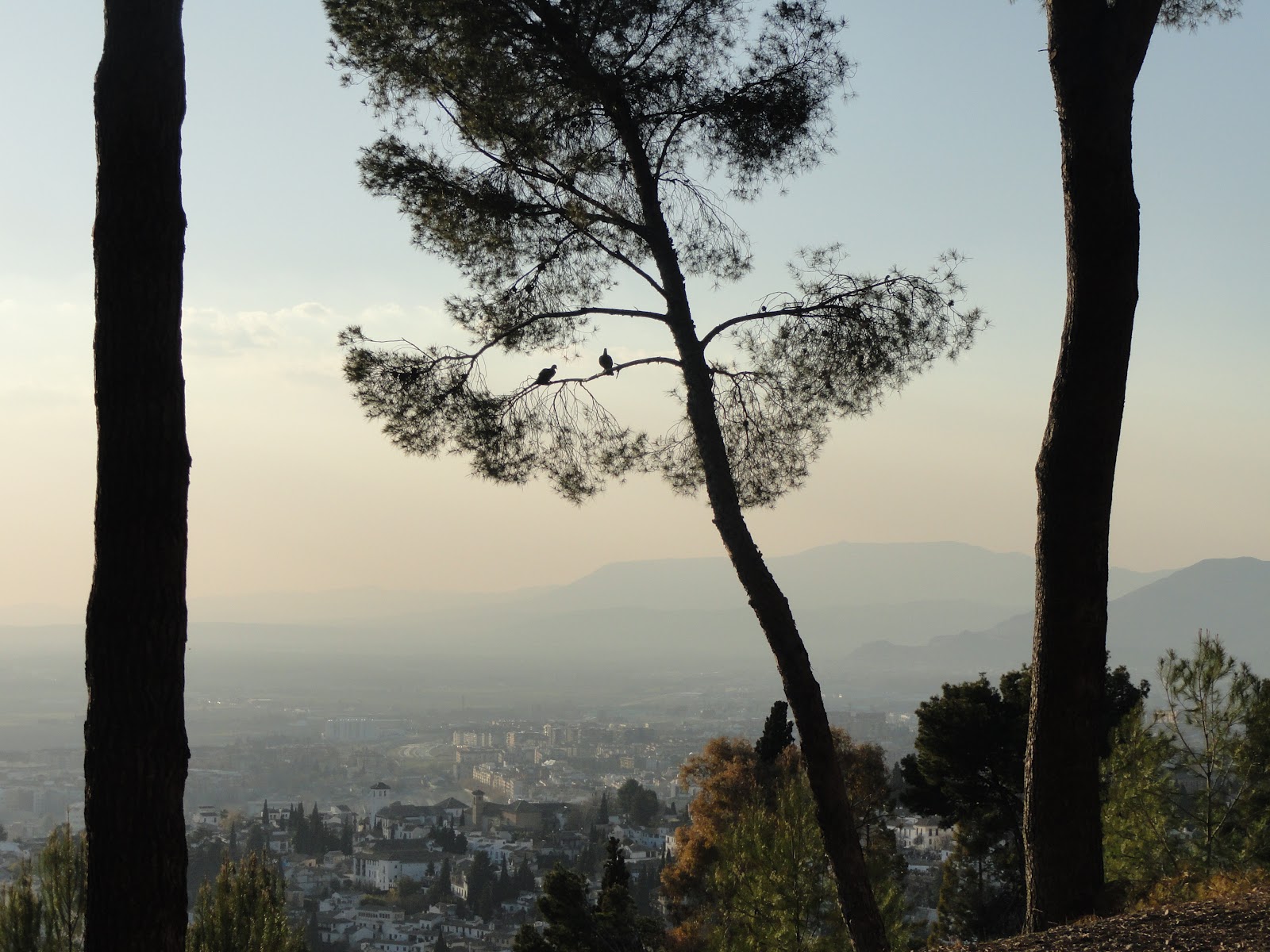
(Just something pretty to look at for this post - this is from a lookout over Granada.)


If you've never played Taboo before, it's a lot of fun. The basic principle of the game is that you draw a card with a noun and a list of other words normally used to describe that noun, written on it. You must convey to your partner or team members the noun written on your card without using any of the forbidden words, as quickly as possible. It requires perseverance and creativity; the game is surprisingly challenging, even for the most dedicated logophile.

I've found that trying to communicate in a language immersion environment is a lot like playing Taboo.... except not only are you missing nouns (vocabulary is invaluable, kids), you are missing verbs, adjectives - entire tenses and many an irregular conjugation. Let me tell you, it's hard to tell a story or explain anything entirely in the present tense, and with knowledge of less than half of the words you would otherwise use.

At the beginning of last semester, I was practically deaf and mute. I felt one dimensional and stupid - I spoke like a caveman and could barely express an opinion. It is shocking to realize how much you take language for granted, when you arrive in a foreign country and don't know how to ask for ketchup at a restaurant or get directions if you are wandering around lost - the effect is surreal. How you communicate yourself to, and receive information from, the world is dependent upon our ability to use language. Forget what all the communication experts tell you about 93% of communication being non-verbal. Sure, I've learned to utilize my gesticulations and facial expressions all the more since coming here, but sometimes playing charades, the extended version is just flailing around scaring the person you are trying to communicate with.

I think that the greatest misconception about study abroad is the idea that by going abroad for a semester or 8 months, you'll come home speaking like a native. Obviously mastery of the language before leaving the United States is a huge factor, but if we're just talking about your average monolingual student, there is no magical transformation to speak of. Speaking and understanding French in France is not like eating baguettes and Nutella in French class in high school. Nor is learning classroom vocabulary (lápiz.... bolígrafo), or the difference between por and para much help when you're on the phone speaking in Spanish with a potential landlord, apartment hunting in Spain.

Not to undermine the amazing opportunity to learn that language immersion will provide you with. You will learn a language exponentially faster and more completely through language immersion in a foreign country. No number of classes at CSU or Rosetta Stone CDs can compare with living and studying within the language, there is no doubt about that. Just remember that human beings are not Pokemon. If you arrive with a beginner or intermediate level, though you are not going to spontaneously evolve into fluency, you will undoubtedly improve enormously in leaps and bounds.

You can learn the language quickly because you will be constantly affronted with the opportunity to learn and practice - not because language immersion is some sort of magic potion. It takes a lot of effort, concentration, and embarrassing conversations to learn a language. Don't assume that you can go to a foreign country, surround yourself with American friends from your study abroad program, waste your time watching your favorite American TV shows on Hulu, Google translate all your homework assignments, and still learn the language. 

To learn the most in what time you have, I recommend constantly forcing yourself to speak the language and avoiding English whenever possible. Meeting and making native friends is also a huge part of not only language, but cultural immersion. As English speakers our widely spread culture and dominant "international language" can be found almost anywhere in the world. For this reason, it takes an enormous will power not to digress into the soft cushion of English language and American culture you could undoubtedly surround yourself in. Don't build yourself a mini-United States in your host country. I know students in my program who Skype their boy/girlfriends every night and always go to the same, English speaking pub with the same group of American and Canadian friends every night. There is nothing wrong with staying in touch with home or making long lasting American friends. Just remember to live in the here and now - you are studying abroad, and this is a once in a lifetime kind of experience. Challenge yourself, break out of your comfort zone, set reasonable goals, and laugh at yourself, even if it is the 17th time you've had to look up that word in your dictionary.

It is a slow, often frustrating, but always rewarding process. Most importantly it is just that. A process, not a miraculous transformation, but something you must work at. 'Poco a poco' all of my Spanish friends tell me. Little by little, I am learning. 


Saturday, March 10, 2012

La Ciudad Eterna

This past weekend, my program took sixty-odd students on a whirlwind (3 night) trip to Rome. It was a wonderful adventure and gave me a much yearned for taste of Italy. I most loved seeing the Vatican museums (including the Sistine Chapel!), visiting the Colosseum, the elegant Trevi Fountain, eating entirely too much pistachio gelato and walking in the city at night in the rain. There is just something so unforgettable about Rome, its long history, sunny air and time-worn color streets seem to cast the city in a sepia tone lens, which in the darkness of night becomes a hazy gold glow. 

There was just so much to see and do. I know I could spend a lifetime here and not know the city well enough, but I left Rome with rubber legs (from walking all over kingdom come!) and a feeling of contentment, that I had in fact done everything I wanted to do.... well, for this trip at least.

I cannot reiterate this enough. My program, API has taken us around Spain (Madrid, Toledo, Cabo de Gata, Seville), on two international trips (Paris, Rome) and still offers us a generous variety of free services and programs. I have American friends in Granada whose programs take them Toledo, maybe Seville - you will thank yourself over and over again in the future if you do thorough research to find the best program for you!

Exploring the birthplace of Western civilization; ruins in the Roman Forum.

The Sistine Chapel in the Apostolic Palace; the Papal conclave where the new Pope is selected, and the site of Michelangelo's most famous fresco (painted between 1508 and 1512). I had to catch myself several times to keep from falling over backwards while craning my neck to admire this beautiful work. You have to be kind of sneaky in here, but no amount of yelling from a few sedentary guards stopped hundreds of people from photographing this amazing place.


One coin to return to Rome, three for love. What I would like to know is how many thousands of euros are dredged from the bottom of this famous fountain every year?

The Trevi Fountain, a masterwork of Baroque design completed in 1762.

Despite a long wait, a free for all heathen line, and a fight with the audioguides, we fought off gladiators dressed in plastic breastplates and spandex to make it into the Colosseum! 

The largest amphitheatre built during the Roman empire, construction began in 72 AD and was completed eight years later. The Roman Forum (a concentration of ruins adjacent to the Colosseum) was also really cool to wander through.

Originally intended as a mausoleum, the Castel Sant'Angelo (Castle of the Holy Angel) isn't nearly as cool as the beautiful view it provides from the top. Also, the last delicious bite of marzipan says hello from over Hannah's shoulder.

Squinting to see in the sunshine, this is the Monument to Vittorio Emanuele II. Nearby is the Doria Pamphilj, a wonderful palace and Renaissance art collection I highly recommend.

Flowers put to bed for the night; I love everything about this picture and this place.


Piazza Navona

View from the top of Castel Sant'Angelo; I love the way the rich yellow of the street lamps bathes this city in a golden glow at night.

My favorite thing I did in Rome: to visit the Vatican museums. It's tempting to blow straight through to the Sistine Chapel, but don't - the fine arts collection is astounding and well worth the time. 


Giving a Roman emperor a kiss (well, Hannah didn't quite make it for this one, 
as a result of the sacrifice made for that banging foot pop).

Julia observing a full moon of night sky (the oculus) in the Pantheon. Once a temple to the gods of Ancient Rome, it is now a Roman Catholic church.

In the Papal Basillica of Saint Peter, which is simply magnificent 
and not to be missed if ever you are in Rome.

According to Roman Catholic tradition, the tomb of the apostle Saint Peter lies beneath this church, and many Popes have been interred here. 

A member of the Papal Swiss Guard. 
(And yes, apparently you really do have to be Swiss to wear the fancy pants.)

Turned to take a photograph of the mountain of artichokes, and realized that someone had left this little thumb sucker parked in her stroller.  The spectrum of cultural trust all over the world still surprises me.

Monday, February 27, 2012

Weekend Girl's Getaway to Ronda and Córdoba

While I can't speak for everyone (especially people who take English classes in their host country), one of the perks to study abroad education is that classes and professors encourage utilizing the study abroad experience. You are here to learn the language and the culture firsthand inside and, more importantly, outside the classroom. Taking grammar, history, literature in Spanish is a lot of work, but it's a very long way from organic chemistry, if you can understand my perspective. While in Fort Collins I would've been in the library or TA hours studying after class and on the weekends, we are instead encouraged to go out and explore. This means lots of time to meet new people, travel, and practice my Spanish first hand. This semester I have decided to redouble my efforts and cram in as much within Spain travel as possible before I have to go home. I want to know my host country, the place I've come to call home, inside and out. After hearing about the nearby picturesque town of Ronda and the beautiful, historical Cordoba, my friends and I decided to take a part of our luxurious 5 day weekend to travel outside Granada and get a better feel for sunny southern Spain, Andalusia. 

The fabulous terrace of our youth hostel (and of course Karina's ever-present neck pillow 
in the foreground).

Looking out over the valley from the cliffs of Ronda.

Main bridge in Ronda (sorry, no bungee jumping here).

Mosaics and other elegant details around town.

In historic Córdoba.

Looking towards the famous Puente Romano on our way to the art museum. 

Cathedral of Our Lady of the Assumption, also known as La Mezquita-Catedral (Mosque-Cathedral), 
a cathedral quite unlike any you've ever seen.


The former Great Mosque of Córdoba; first a Visigothic Christian church, converted into a mosque by the Moors before being reverted into a Roman Catholic church after the Spanish Reconquista.


In the process of making your decision to travel abroad, I recommend you consider the location of your host city/country and its accessibility. I ultimately chose Spain over Argentina because I knew it would be easier as a novice traveller to country hop in Europe, and because the public transportation and tourism possibilities within Spain are seemingly endless. So when you do go abroad, take every advantage of traveling. I try to find a balance, between loving my time at home living and studying in Granada, traveling in Spain, and traveling around Europe. Other travel goals this semester; Bilbao, Cadiz, Salamanca and Valencia within Spain; Morocco and Portugal outside of Spain. Next weekend I will be headed to Rome with my entire program, so at least I'll have that knocked out of the water! 

Thursday, February 16, 2012

Estar de vuelta en Granada....

After five weeks of living like a nomad out of a backpack the size of a Ninja Turtle shell, I was more than a little Spain-sick by the time I was homeward bound. And by home I do mean Granada. Maybe I was at long last tired of standing on tiptoe in potentially MRSA infected hostel showers, or of having to roll even my dirty clothes into neat little cylinders to re-pack every morning and evening. Or maybe I just wanted to sleep in the same bed for more than two nights in a row. Whatever it was, I was relieved to go home to Spain. Strange to think that I missed Spain specifically - not the United States, not Colorado, but Spain. I got back here two weeks before school started, which despite my worrying turned out to be plenty of time to find a great apartment, settle in, prepare for classes and even get a little stir crazy (after so many weeks of limitless liberty, it was bound to happen).

Coming back for round two has made me all the more thankful for this amazing experience. While the shock of living abroad has subsided, the wonder and novelty of it all remains, and I am more appreciative than ever to be here. Saying goodbye to so many semester-long friends and acquaintances in December made me realize just how lucky I am to be here for the full eight months. If you are considering your own study abroad experience, take all factors into account and don't sell yourself short! Studying abroad for a full academic year has been the best decision of my undergraduate career, and even for those of you who are afraid they will get homesick, I recommend seriously considering stretching your limits and if possible, finding a way to stay for two semesters.


First weekend after the start of school, we got a hankering to climb up into the Sacromonte, the historically Gypsy neighborhood in north-east Granada. Now that I have only 4 months left, I feel the urgent need to explore every nook and cranny in Granada! These photos are from an exploratory hike around the Sacromonte:

So many churches and crucifixes, but for me they never get old. 

Looking towards the Sierra Nevada from the Sacromonte, an old, traditonally gitano quarter of Granada.

Ever-fresh flowers outside the Sacromonte Abbey.

Street artist and a fascinated spectator.